Education
Agentic DevOps: From CI/CD to Self-Healing Pipelines
Feb 2, 2026
Introduction
DevOps has drastically transformed how teams build and run software. Companies rely on CI/CD pipelines to automate build and release tasks. This approach improves speed and quality. Still, modern systems face new problems. Cloud platforms scale fast while microservices change often. Manual efforts for fixing errors slow team progress. Agentic DevOps solves this gap by adding intelligent agents to DevOps workflows. These agents observe systems, decide a course of action and resolve issues by themselves. This shift moves DevOps from automation to autonomy. DevOps Certification Course helps professionals validate real-world DevOps skills and improve career growth.
Understanding Agentic DevOps
Agentic DevOps uses autonomous software agents. These agents act with clear goals. They use data to reason state or situation, and then take action based on relevant data. Agentic DevOps stands out because it can function accurately without human commands. Traditional DevOps follows fixed rules. Agentic DevOps, on the other hand, adapts itself at runtime. Agents learn from logs. They read metrics, analyse traces and respond to changes in real time. This makes pipelines smarter and more resilient.
Evolution of CI/CD Pipelines
Classic CI/CD pipelines follow linear stages. The steps include:
· Code moves from commit to build.
· Developers run tests.
· The pipeline gets deployed.
· Errors stop the pipeline.
· Engineers manually check for errors.
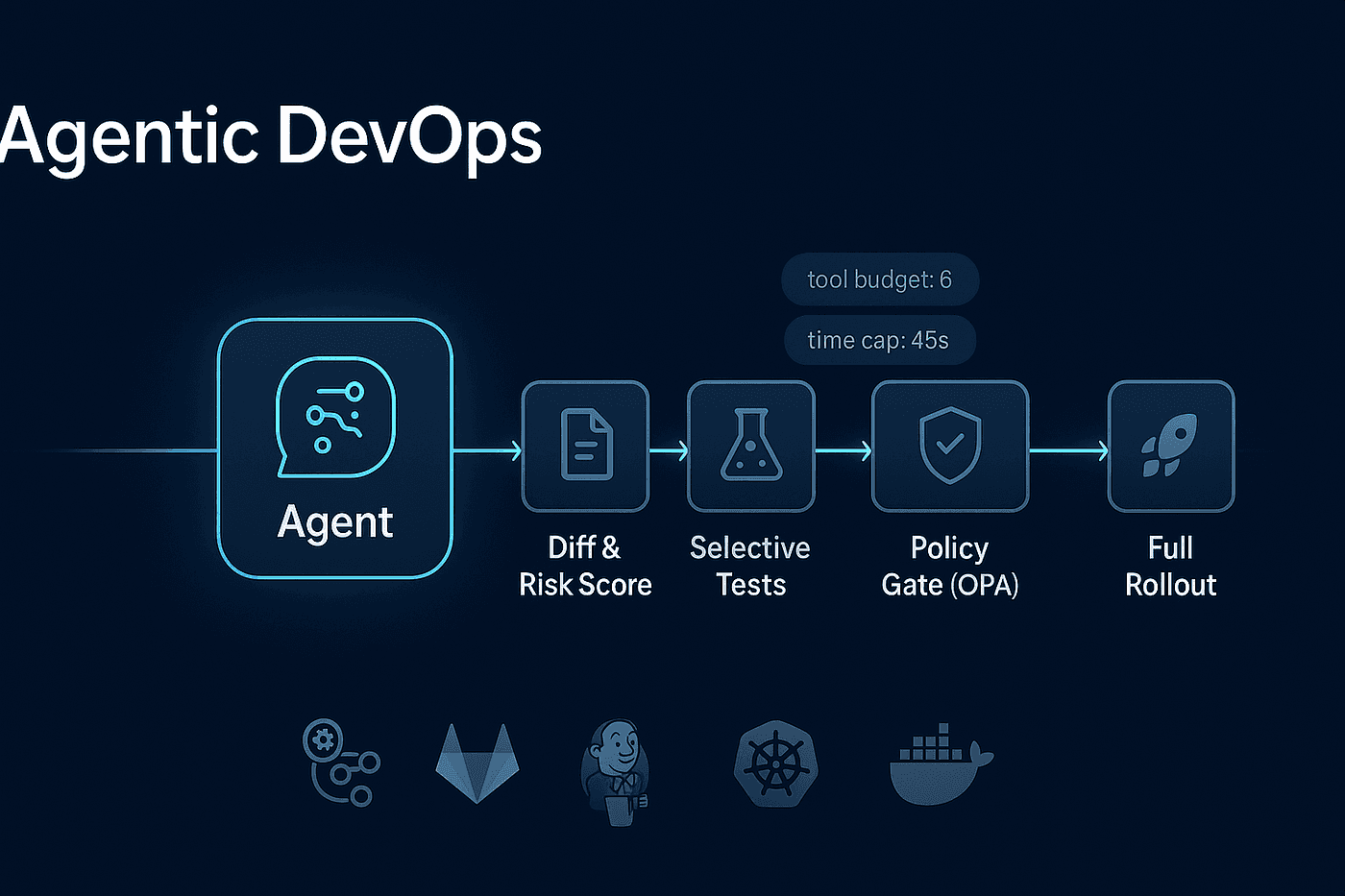
Although this model works for small systems, it fails at a larger scale. Modern platforms deploy many times a day which change the dependencies. Agentic pipelines handle this complexity effortlessly. The key stages of Agentic Pipelines include the following:
· Agents monitor each stage.
· They adjust steps dynamically.
· They retry tasks with new parameters.
· They choose safe rollout strategies.
Role of AI Agents in DevOps
AI agents act as decision makers. They use machine learning models and apply policy engines. They work with context. An agent watches CPU usage to detect abnormal spikes. It predicts failure risk and triggers scaling before there is any outage. Another agent reviews test failures. It compares past results, labels tests and re-runs them in isolation. False alerts get reduced. As a result, minimum human interference is required. The DevOps Course with Placement offers state-of-the-art facilities for the best training for learners.
Self-Healing Pipeline Architecture
Self-healing pipelines fix problems automatically. Agents sit across the pipeline and connect with monitoring tools, CI servers and cloud APIs to function. When a build fails, the agent checks the logs. Agentic DevOps identifies issues from the roots and adopts effective measures to resolve them. It patches configs and restarts jobs. The agent watches health probes during deployment. If the error rate rises, it rolls back safely. Healing happens without tickets.
Observability as the Brain
Agentic DevOps depends on observability. In this, metrics show performance, logs show behaviour, and traces show flow. Agents use this data as input and correlate signals across layers. They detect weak signals early for prompt action. As a result, the system fixes itself before users notice issues. Each incident like this improves future decisions. DevOps Online Course offers flexible learning with live projects and cloud-based tools.
Security and Policy Control
Autonomy needs control. Agentic DevOps uses policy-as-code, wherein policies define allowed actions. Agents respect guardrails and must not break compliance. Security agents scan builds, detect vulnerable libraries and block unsafe releases. They open automated fixes which keeps pipelines secure by default.
Benefits for Modern Teams
Below are some benefits of DevOps for modern teams:
· Agentic DevOps increases uptime.
· It reduces mean time to recovery.
· DevOps lowers alert fatigue.
· Teams focus on design.
· Systems handle routine failures.
· Release confidence improves.
· Cost control improves due to smart scaling.
· DevOps becomes predictive instead of reactive.
Conclusion
Agentic DevOps marks the next stage of automation. CI/CD pipelines gain intelligence. Self-healing systems become real. Agents observe, decide, and act. They reduce human effort. They improve resilience. DevOps Course in Noida provides classroom training with industry-aligned curriculum and expert mentors. As systems grow complex, Agentic DevOps becomes a necessity. The technology offers more speed and accuracy to teams with minimal human intervention. Thus, modern DevOps is shifting from managing tools to driving autonomous systems.