Education
Key SAP FICO Concepts Every Finance Professional Must Know
Mar 2, 2026
Introduction
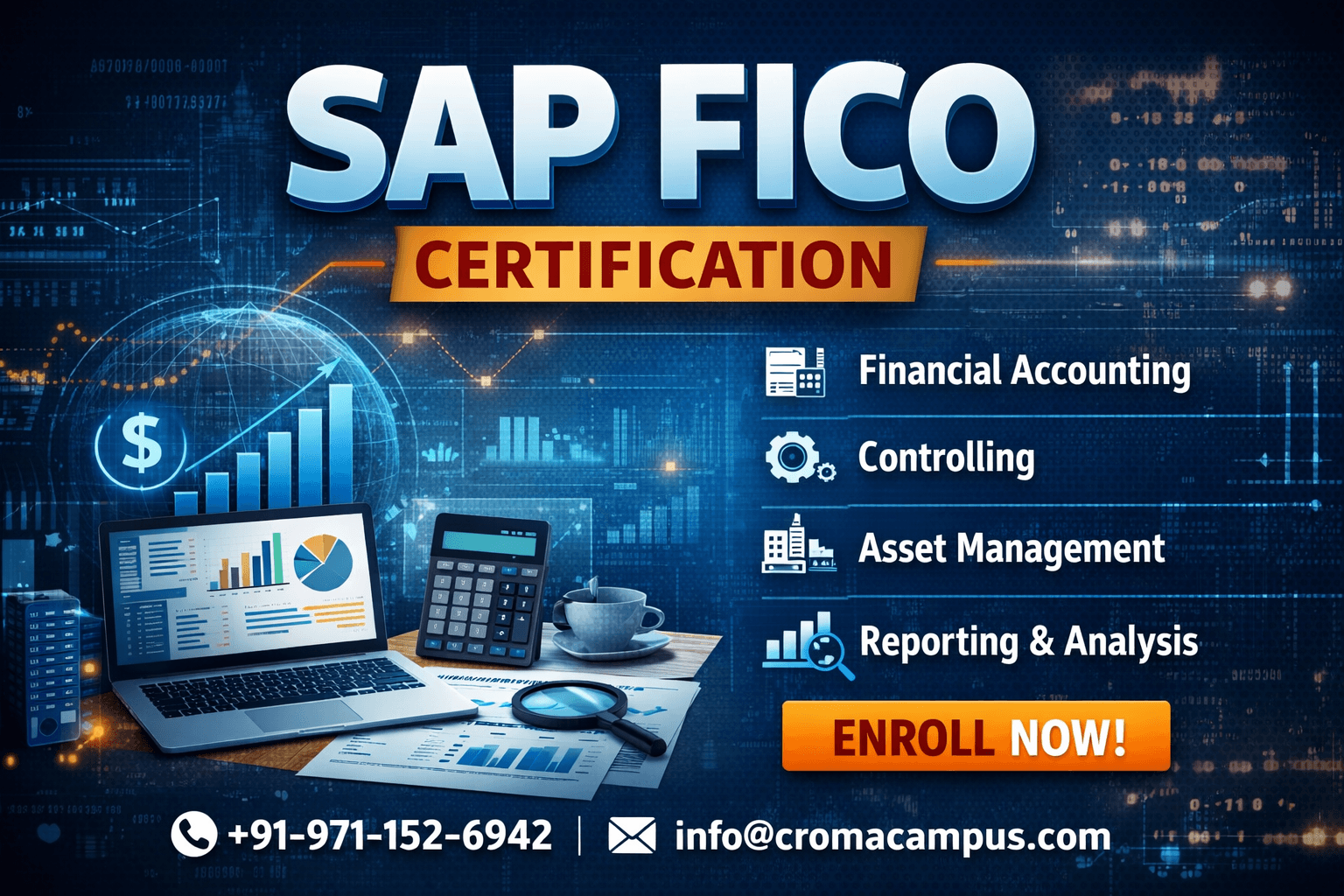
SAP FICO stands at the core of enterprise finance. It drives accounting accuracy. It enforces compliance. It delivers real time control over money flow. Every finance professional who works in an SAP environment must understand its core concepts. SAP FICO combines Financial Accounting and Controlling in one integrated system. It records transactions. It monitors costs. It supports strategy. Strong knowledge of these concepts builds confidence and improves decision making. SAP FICO Course helps finance professionals master real-time accounting and controlling processes in SAP systems.
Important SAP FICO Concepts
Here’s a list of the major SPA FICO concepts.
Understanding Financial Accounting (FI)
Financial Accounting manages external reporting. FI tracks legal books of accounts. It further ensures that regulatory compliances are followed.
· General Ledger (G/L): This is the backbone of SAP FI that stores all financial transactions of the company. Each posting updates G/L accounts in real time. It supports parallel accounting. It allows multiple ledgers for IFRS and local GAAP.
· Accounts Payable (AP): Accounts Payable manages vendor payments. It tracks liabilities. It records invoices. It controls outgoing payments. Vendor subledger accounts and reconciliation accounts in the G/L are linked together. This ensures automated balance updates.
· Accounts Receivable (AR): This component manages customer invoices and monitors incoming payments within the organization. It tracks outstanding dues. It calculates interest on delayed payments. The system updates customer balances instantly after posting.
· Asset Accounting (AA): Asset Accounting manages fixed assets. It tracks asset acquisition. It calculates depreciation. It posts depreciation to the G/L. It supports multiple depreciation areas. Compliance with accounting standards are maintained by AA.
Understanding Controlling (CO)
Controlling in SAP FICO manages internal reporting in organizations. It focuses on cost control and profitability analysis. The SAP FICO Online Training offers hands-on learning opportunities using the FICO tools.
· Cost Element Accounting: Expenses and revenues are classified by cost elements. Primary cost elements connect with G/L accounts. Internal allocations are managed by Secondary cost elements. This structure ensures cost tracking at deeper levels.
· Cost Center Accounting: These are the departments or units. They capture overhead costs. Managers analyse expenses generated by every department in the organization. Planning and variance analysis is made easier with cost center accounting.
· Internal Orders: Temporary costs are tracked by internal orders. Companies use them for projects or events. They monitor budgets. They control spending. They settle costs to final cost objects.
· Profit Center Accounting: This component measures business performance. They evaluate revenue and cost. They support segment reporting. They enable decentralized accountability.
· Profitability Analysis (CO-PA): CO-PA analyses profit by product, region, or customer. It captures revenue and cost of sales. It supports market strategy. It provides real time margin reports.
Integration Between FI and CO
SAP FICO integrates tightly. Every FI posting can create a CO document. A vendor invoice updates G/L and cost center simultaneously. This integration ensures data consistency. It eliminates duplication. It provides a single source of truth. SAP FICO Certification validates your expertise and increases your career opportunities in global finance roles.
Organizational Structure
SAP FICO uses defined organizational units. The Company Code represents a legal entity. The Controlling Area links cost accounting units. The Business Area supports segment reporting. Correct structure design ensures clean reporting.
Reporting and Compliance
SAP FICO supports financial statements. It generates Balance Sheets. It produces Profit and Loss reports. It enables cash flow analysis. It supports audit trails. Every transaction stores document numbers. This ensures traceability.
Key SAP FICO Concepts Summary
Concept | Module | Purpose |
General Ledger | FI | Records all financial transactions |
Accounts Payable | FI | Manages vendor liabilities |
Accounts Receivable | FI | Manages customer payments |
Cost Center Accounting | CO | Tracks departmental costs |
Profitability Analysis | CO | Analyzes profit by segment |
Conclusion
SAP FICO forms the financial backbone of an enterprise. It records transactions with precision. FICO controls costs with clarity. Strategy and strong analytics form the core of FICO. Major components of FICO include G/L, AP, AR, Asset Accounting, Cost Centers, and CO-PA, etc. the SAP FICO Training in Hyderabad is designed for beginners and offers training in every aspect from scratch. Professionals must have strong knowledge of FI and CO for work efficiency and accuracy. FICO is an essential component in every modern organization. Therefore, FICO training can be a wise career decision.