Education
SAP FICO Architecture Explained
May 16, 2026

Introduction
You will often hear that SAP FICO is the backbone of enterprise finance. That sounds vague. Let’s make it concrete. SAP FICO architecture defines how financial data flows, gets stored, and produces reports. Business transactions connect with accounting logic for efficiency. Understanding this architecture enables you to work like a system designer instead of memorizing steps. The SAP FICO Course is designed for beginners and offers ample hands-on training opportunities.
What Do You Really Mean by SAP FICO Architecture?
SAP FICO architecture goes beyond modules and uses a layered system.
Entry of data inside the system is controlled
Posting processing is defined
FICO stores all financial records using structured tables
Reporting becomes more consistent with FICO
Thus, FICO acts like a pipeline. Data flows from operations into finance. Then it gets validated. Then it lands in the ledgers.
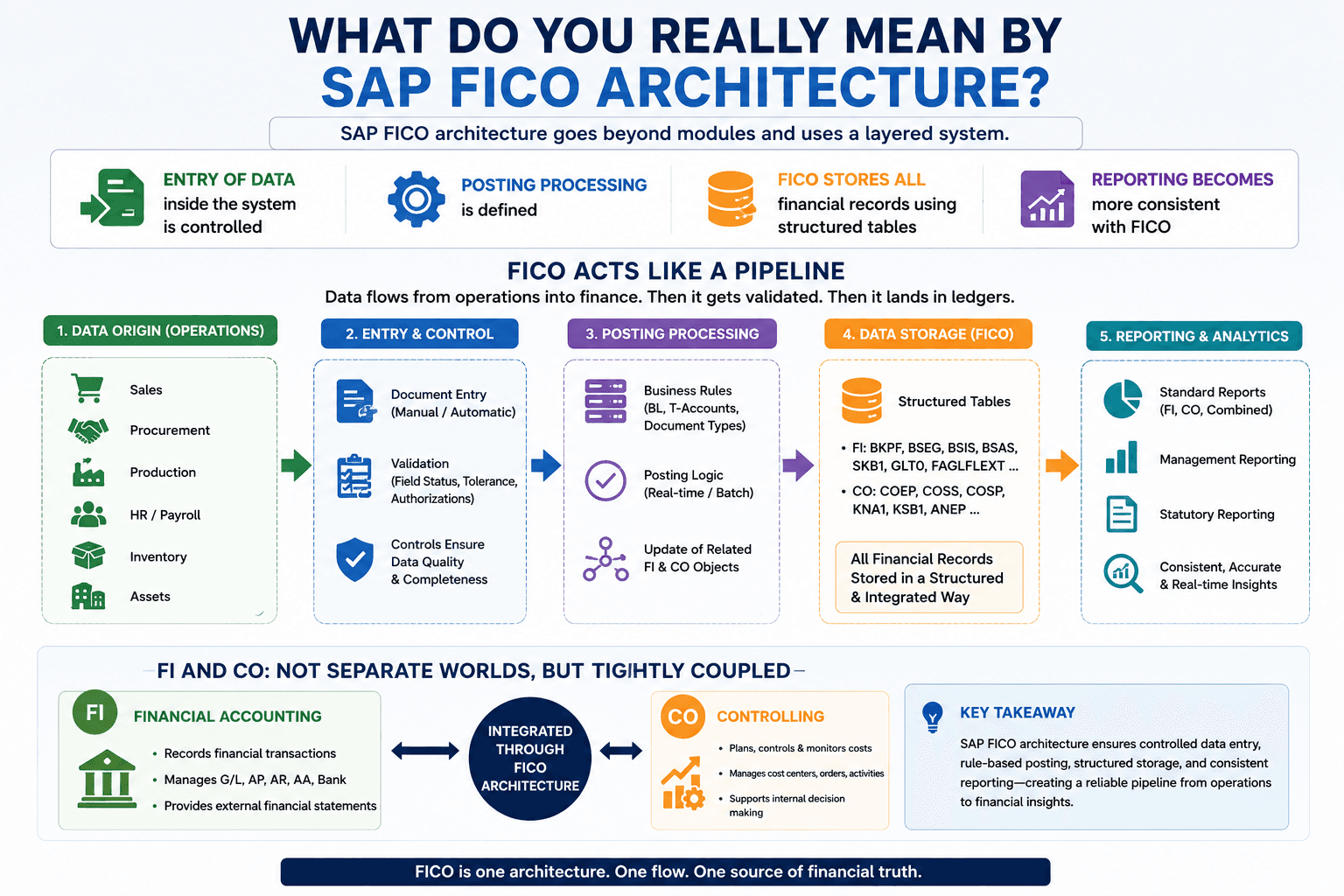
When I first worked on a project, I thought FI and CO were separate worlds. That was wrong. The architecture tightly couples them.
Core Architectural Layers
Presentation Layer
This is where you interact
SAP GUI or Fiori apps sit here
You trigger transactions like FB50 or F-02
Simple idea. You give input. The system captures it.
Application Layer
It functions as the brain of the system
Business logic is applied
Entries get validated for accuracy
Accounts are determined
Example:
Every time you post an invoice, the system checks elements like currency, company code, account rules, etc. If something breaks, it usually breaks here.
Database Layer
This is the storage engine
Tables like BKPF and BSEG store entries
Master data tables store customers and vendors
Table Name | Purpose | Simple Meaning |
BKPF | Document Header | Stores main document info |
BSEG | Line Items | Stores transaction details |
SKA1 | G/L Master | Stores account definitions |
You do not need to memorize all tables. You just need to understand the structure.
SAP FICO Training gives you hands-on exposure to real-time posting logic, table structures, and FI-CO integration within system architecture.
FI and CO Integration Architecture
This is where things get interesting.
Financial Accounting (FI)
Records external transactions
Produces balance sheet and P&L
Works with G/L, AR, AP
Controlling (CO)
Tracks internal costs
Works with cost centers and profit centers
Helps decision-making
Component | Role | Example |
FI | External reporting | Financial statements |
CO | Internal reporting | Cost tracking |
Now here is the key insight. Every FI posting can trigger a CO posting.
I remember debugging a cost issue once. The FI document looked correct. The problem was in the CO allocation. That is when I understood integration deeply.
Document Flow Architecture
SAP FICO runs on a document principle.
Every transaction creates a document
Each document has a header and line items
Documents remain immutable
Why does this matter?
Because auditability becomes strong.
Example flow:
Sales order created
Billing happens
FI document gets generated
You never overwrite. You only reverse and repost.
Organizational Structure Mapping
SAP architecture depends heavily on structure.
Company Code → Legal entity
Business Area → Internal reporting unit
Controlling Area → Cost management scope
Simple explanation:
The above units define where the data comes from. If you configure them incorrectly, your entire reporting fails.
SAP FICO Certification validates your knowledge of SAP FICO architecture, including configuration, organizational structure, and reporting flow.
Real-Time Integration with Other Modules
SAP FICO does not work alone.
An invoice verification enables MM integration
SD uses billing to integrate effectively
PP integrates with the help of production costing
Example:
Once users receive goods in MM, the System automatically generates an accounting entry.
Data Flow and Posting Logic
Posting gets triggered by Transactions
The system uses configurations to determine accounts
Entries hit the FI tables
Parallel entries flow into CO
Key concept: Automatic Account Determination
In this, the system decides accounts according to the existing rules. You do not manually choose every time.
Conclusion
SAP FICO architecture is not about screens. It is about flow, control, and structure. Once you see how layers connect, confusion disappears. SAP FICO Classes in Pune focus on practical learning of SAP FICO architecture with real scenarios, system navigation, and transaction-level understanding. You start predicting system behaviour. That is when real learning begins. Focus on integration and document flow. Practice with real transactions. Over time, the architecture stops feeling complex and starts feeling logical.