Education
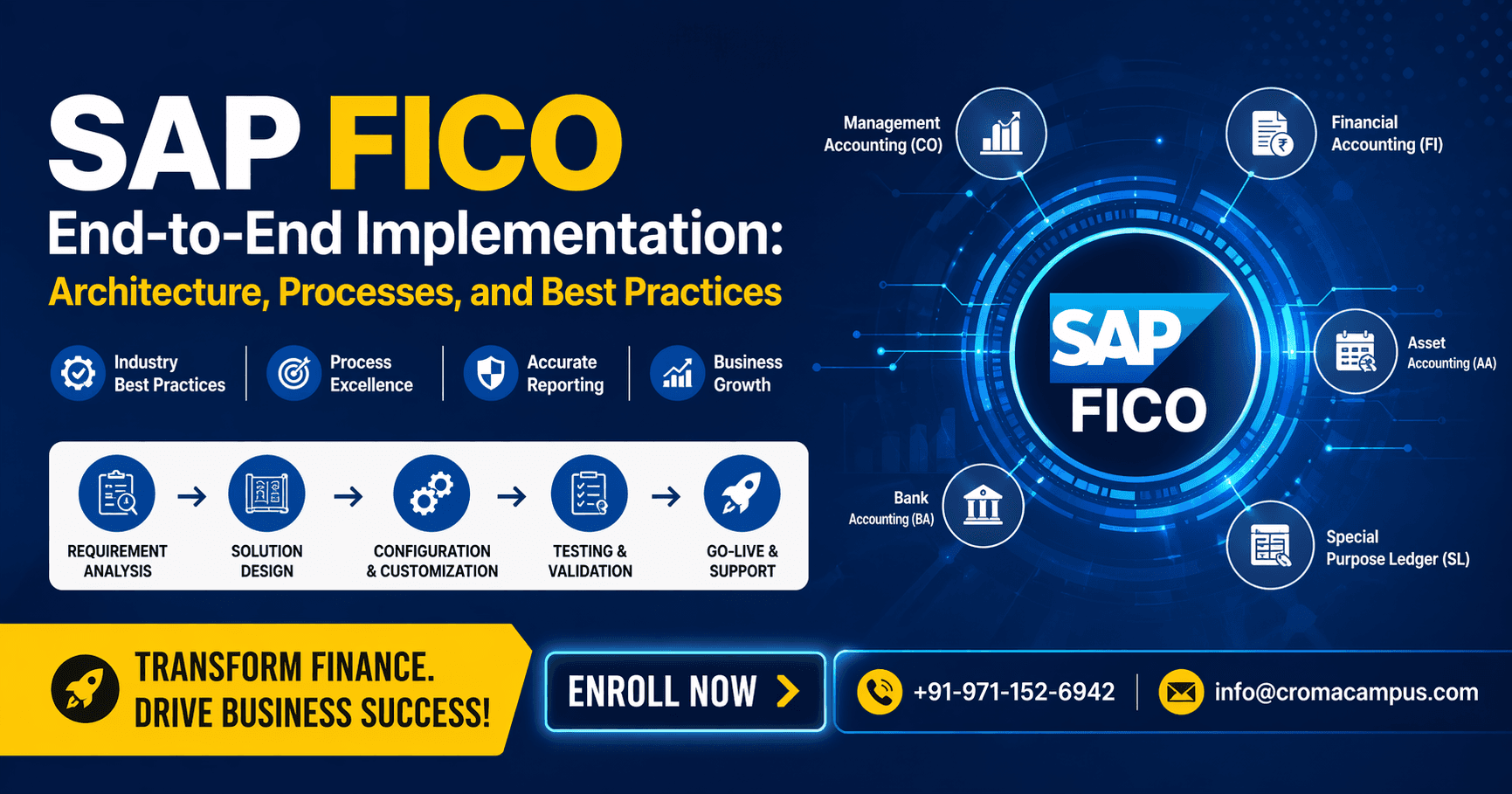
SAP FICO End-to-End Implementation: Architecture, Processes, and Best Practices
Apr 21, 2026
Introduction
The data-driven business world has to handle accounts, reports, and regulations. Organizations employ the SAP FICO (Financial Accounting and Controlling) financial structure. This key component of SAP effectively automates financial operations and obtains real-time insights.
New SAP professionals need to take up a SAP FICO Online Course to know the process of implementing end-to-end SAP FICO. They will learn the architecture and best practices through this course.
Transform Your Business with SAP FICO Processes
SAP FICO is the main element of the SAP ERP system. It manages the business reports and financial transactions. The two key modules comprise:
FI (Financial Accounting): It oversees external reporting, financial statements, and regulations.
CO (Controlling): It manages the budget, controls internal costs, and analyzes the profit level.
SAP FICO provides several financial procedures for the business processes:
Financial Accounting (FI)
General Ledger Accounting
Accounts Payable and Receivable
Bank Accounting
Financial Reporting
Controlling (CO)
Cost Element Accounting
Profit Center Accounting
Internal Orders
Product Costing
Profitability Analysis (CO-PA)
How to Implement SAP FICO Architecture Effectively?
A proper infrastructure laid the successful deployment of SAP FICO. It has a typical multi-layered design:
1. Presentation Layer
User interface (SAP GUI or Fiori)
Enables communication with financial data
2. Application Layer
Business logic and processing
Handles modules like General Ledger (GL), Accounts Payable (AP), and Accounts Receivable (AR)
3. Database Layer
Keeps financial and master data
Confirms data consistency and real-time access
4. Integration Layer
SAP FICO combines with other modules like MM (Material Management), SD (Sales and Distribution), and HCM
In the advanced stage of SAP FICO Training in Hyderabad, teach the learners this layout design.
End-to-End SAP FICO Implementation Method
The implementation process of SAP FICO aligns with ASAP or Activate frameworks. It follows an organized methodology.
1. Project Preparation
Define the scope and goals of the project
Identify stakeholders and assets
Create a project plan
2. Business Plan
Compile the business requirements
Connect current procedures to SAP solutions
Document functional specifications
3. Phase of Realization
Set up the SAP FICO modules:
General Ledger (GL)
Accounts Payable (AP)
Accounts Receivable (AR)
Asset Accounting (AA)
Cost Center Accounting (CCA)
Perform unit testing
4. Integration Testing
Audit end-to-end business processes
Make sure other modules integrate easily
5. Final Preparation
Data migration from outdated systems
Training and documentation for users
System performance testing
6. Launch and Assistance
Place the system into production
Observe system performance
Continue to support and improve
Students in SAP FICO Course in Pune gain live experience on the deployment procedures.
Best Practices for Using SAP FICO
In every SAP FICO Course, trainers give tips on how to maintain well while applying the SAP solution.
Mention clearly the analysis requirements in detail.
Use automation tools to remove old data and migrate data to another place.
Using the SAP features reduces complexity in development.
Provide end users with full instructions and ensure alignment of all parties.
Conduct unit, integration, and user acceptance testing (UAT). It will help to diagnose and resolve problems early.
Keep monitoring the system performance and improve the implementation process based on feedback.
Summary
Although operating the SAP FICO is a bit difficult yet profitable for financial transparency. Following the framework design will aid in the installation process. Expert professionals are going through SAP FICO Training to ensure the successful deployment and smooth running of the business.